Streamline Your Officiant Business
In the wedding industry, the first impression often happens before you even meet the couple. It happens in the email with your Wedding Officiant Service Client Intake form, or in the PDF contract you send over for signatures. While many ministers focus solely on the ceremony script, the administrative side of your business is just as critical for establishing trust. A disorganized intake process can lead to confusion regarding venue logistics, payment disputes, or missed custom vow requests. Conversely, a structured, professional approach signals that you are a serious business owner who values their time and theirs.
The Anatomy of a Professional Client Intake
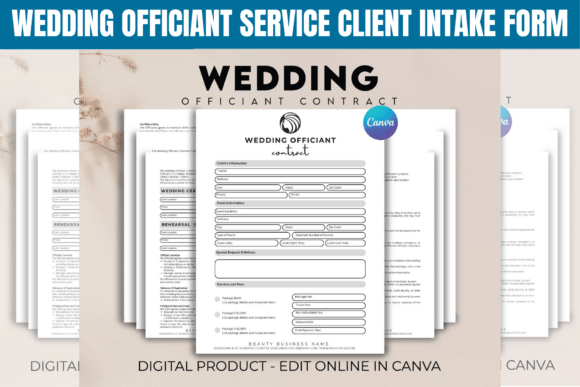
A Wedding Officiant Service Client Intake is far more than just a contact sheet. It is the foundational document of your client relationship. Visually, it should embody the solemnity and joy of the occasion while maintaining the crispness of a legal document. Think of it as the bridge between a Vendor Form and a heartfelt Ceremony Planning Questionnaire. The "personality" of this document needs to be balanced; it must be authoritative enough to cover liability and cancellation policies, yet warm enough to encourage clients to share their love story details.
When designing or selecting a template for this, the layout is key. You need clear sections for distinct data sets. For example, the "Client & Wedding Information" section requires rigid structure—names, dates, and venues should be easy to scan quickly. However, the "Ceremony Planning" section requires open space for narrative answers. A well-designed Wedding Officiant Service Client Intake uses visual hierarchy—through bold headings and ample white space—to guide the user's eye from the logistical data to the creative planning stages.
This document acts as a Wedding Registrar Template as well. You are collecting data that will eventually be written onto the official marriage license. Errors here are not just inconvenient; they can be legally problematic. Therefore, the typography and layout must prioritize legibility over decorative flair. A clean sans serif font is often best for form fields where clients need to write, ensuring that a "2" doesn't look like a "Z" when handwritten.
Visual Identity and Brand Consistency
For the creative professional or small business owner, your paperwork is an extension of your brand identity. If your website features elegant script fonts and soft pastels, but your intake form is a stark, black-and-white generic Word document, you create a jarring disconnect. The visual characteristics of your Wedding Officiant Service Client Intake should mirror your other design assets.
This is where the concept of a premium font comes into play—not just for your logo, but for your paperwork. Using a high-quality serif font for headings on your contract can lend an air of permanence and tradition, which fits the gravity of a Marriage & Wedding Minister Service Agreement. Meanwhile, a modern, geometric sans serif font for the body text ensures that the terms regarding payment schedules and travel fees are readable on both screen and paper.
Consider the "personality" of your service. Are you a modern, secular celebrant? A minimalist, modern typography style with plenty of whitespace might suit your Wedding Vendor Form. Are you a traditional church minister? A layout featuring classic margins and perhaps a subtle border might be more appropriate. The goal is consistency. When a client opens your Wedding Officiant Service Client Intake, they should immediately recognize it as coming from the same professional they saw on Instagram or met at a bridal expo.
Practical Application: Beyond the Wedding Day
The utility of a robust intake system extends into every facet of your marketing and operations. While the primary function is data collection, the document itself serves as a marketing touchpoint. When you deliver a professional invoice or receipt that matches the visual style of your intake form, you reinforce your professionalism. This consistency builds trust, which is the currency of the wedding industry.
Where does this fit in your workflow? It starts with web design. Ideally, your Wedding Officiant Service Client Intake should be available as a fillable PDF or integrated into your website backend. If you are using a template editable in tools like Canva, you can easily export it for digital use or print. This versatility is crucial for packaging design—in this case, the "package" being the bundle of documents you present to a couple upon booking.
Furthermore, the structure of your intake form influences your editorial design capabilities. By gathering detailed information about the couple—how they met, their values, inside jokes—you are gathering the raw material for the ceremony script. A well-structured Ceremony Planning Questionnaire acts as a prompt, helping you write a personalized speech without hours of back-and-forth emails. It turns a chaotic process into a streamlined content creation workflow.
Choosing the Right Template and Typography
When selecting a template for your Wedding Officiant Service Client Intake, look for adaptability. Can you change the colors to match your logo design? Is the file format compatible with your workflow (e.g., Canva, Word, InDesign)? A rigid template that cannot be customized to fit your specific service terms—such as specific clauses for destination weddings or religious requirements—is of little use.
From a typography standpoint, avoid using overly stylized handwritten fonts or complex script fonts for the actual contract clauses. While they look beautiful on social media graphics, they are a nightmare to read in legal text. Instead, use a creative font pairing: a decorative display font for the title "Service Agreement" paired with a highly legible commercial font for the terms and conditions.
Finally, think about the font pairing across your entire suite. The font used on your intake form should harmonize with your brand identity. If your brand is modern and clean, stick to sans-serifs. If it is classic and romantic, a traditional serif might be your anchor. By treating your Wedding Officiant Service Client Intake not just as a formality but as a key piece of your design assets, you elevate the client experience from the very first click.