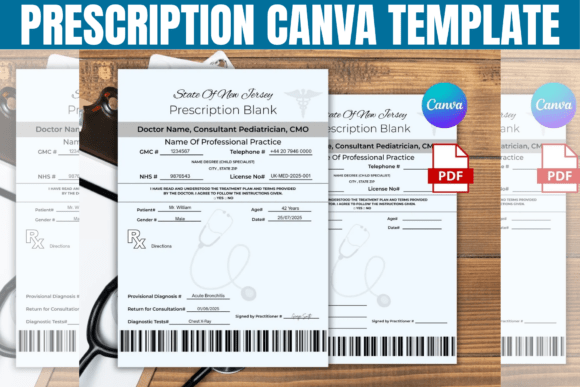
Editable Prescription Canva Template: Realistic Medical Design Assets
Creating professional, customized prescription sheets, pharmacy labels, and medicine templates doesn't require advanced design skills or expensive software. The Editable Prescription Canva Template provides a versatile, realistic design pack that lets you produce polished medical documents in minutes. Whether you're a medical student preparing educational materials, a clinic administrator organizing office documents, or a designer working on health-themed creative projects, this template set delivers adaptable layouts that look authentically professional.
What Makes This Template Set Stand Out
The visual character of these templates mirrors standard pharmaceutical documentation you'd encounter in real clinical settings. Clean typography, structured layouts, and realistic field placements create an immediate sense of legitimacy. Each element—from the prescription pad header to the pill bottle label design—follows established formatting conventions used across healthcare facilities. This attention to detail means your finished documents won't just look good; they'll look right.
The overall appeal lies in its balance between professionalism and flexibility. The design doesn't lean too clinical or too casual. Instead, it occupies that practical middle ground where medical accuracy meets creative adaptability. You'll find consistent spacing, logical information hierarchy, and clear visual separation between different data fields. These aren't decorative mockups—they're functional templates built for real-world application.
Where These Templates Work Best
The applications extend far beyond obvious medical uses. Here's where the Editable Prescription Canva Template truly shines:
- Educational settings: Medical and nursing students use these for practice documentation, simulation exercises, and classroom demonstrations. Educators create realistic teaching aids without compromising patient privacy.
- Clinic mock-ups: Healthcare startups and new practice owners design stationery samples before committing to commercial printing. Test different branding approaches with actual document layouts.
- Creative projects: Filmmakers, theater producers, and content creators need convincing props. These templates produce screen-ready prescription pads and pharmacy labels that hold up under scrutiny.
- Health awareness displays: Community health organizations create informational materials that borrow the authority of professional pharmaceutical design while delivering educational content.
- Office organization: Some professionals use the label templates for organizing medication storage, filing systems, or inventory management in healthcare-related businesses.
The template set's versatility makes it valuable across brand identity development for health-related businesses, packaging design concepts for wellness products, and even editorial design for publications covering medical topics.
Understanding the Design Structure
Each template in this pack follows a logical information architecture. The prescription pad template includes standard fields: patient name, date, medication details, dosage instructions, prescriber information, and signature line. The pharmacy labels feature medication name, dosage, instructions, pharmacy details, and prescription number fields. Pill bottle labels incorporate compact layouts that prioritize readability at small sizes.
This structured approach influences how viewers process information. Clear visual hierarchy guides the eye naturally from header to details to footer. Consistent alignment creates order. Appropriate white space prevents visual clutter. These design principles aren't just aesthetic choices—they directly impact how quickly and accurately someone can read the finished document.
The templates come in both US Letter and A4 sizes, covering standard document dimensions used across different regions. This dual-format approach ensures your designs work whether you're printing domestically or preparing materials for international distribution.
Customization Without Complexity
Everything happens inside Canva's interface. No specialized software. No steep learning curve. After purchasing, you'll receive a PDF containing direct links to your Canva templates. Open these links with a free Canva account, and every element becomes editable.
Change patient details, swap medication information, adjust dosage text, replace provider names, and modify clinic branding. Upload your own logos. Switch fonts if your brand guidelines require specific typeface choices. Adjust colors to match your organization's palette. The flexibility extends to every visible element on each template.
This level of customization matters for brand consistency. When your prescription pads, pharmacy labels, and medicine templates share unified visual language—matching colors, complementary fonts, consistent logo placement—they reinforce professional credibility. Patients, partners, and stakeholders notice these details, even subconsciously.
Practical Tips for Getting the Most Value
Before diving into customization, spend a few minutes planning your approach:
- Gather your assets first. Have your logo files, brand colors (hex codes), preferred fonts, and standard text ready before opening the templates. This prevents repetitive back-and-forth editing.
- Test print before committing. Print a sample on your intended paper stock. Labels behave differently on various materials. What looks sharp on screen might need adjustment for specific label paper textures.
- Consider your audience's expectations. A prescription pad for a pediatric clinic might benefit from warmer colors than one designed for a cardiology practice. Match the visual tone to the context.
- Save multiple versions. Keep a master template unchanged. Create separate copies for different use cases. This preserves your starting point and lets you branch projects without rebuilding.
- Review at actual size. Zoom to 100% in Canva before finalizing. Small text that looks fine zoomed in might become illegible when printed at physical dimensions.
Printing and Digital Applications
The templates serve both print and digital workflows equally well. For physical output, save your finished design as a high-resolution PDF. Print on standard paper for prescription pads or on adhesive label sheets for pharmacy and medicine labels. Many users find that slightly heavier paper stock (24lb or higher) produces more convincing prescription pads with better handling characteristics.
For digital use, export as PNG or JPG files. These work well in presentations, training modules, website mockups, or social media graphics. Healthcare bloggers and content creators often use these templates as visual elements in educational posts, adding authenticity to their health-related content without using real patient information.
Why Realistic Design Templates Matter
In a world saturated with generic clipart and obviously fake mock documents, realistic templates carry distinct weight. They communicate competence. They suggest attention to detail. They bridge the gap between conceptual planning and tangible output.
For medical students, practicing with realistic documentation builds muscle memory for actual clinical workflows. For entrepreneurs launching health-related products, professional-looking labels and materials establish early credibility. For designers serving healthcare clients, having quality starting templates accelerates project timelines significantly.
The Editable Prescription Canva Template set functions as practical design assets rather than mere decoration. Each template solves specific communication needs—conveying medical instructions clearly, presenting pharmaceutical information professionally, organizing health-related materials systematically.
Whether you're building a complete brand identity for a new clinic, creating social media graphics for a wellness brand, or developing teaching materials for healthcare education, these adaptable templates provide a reliable foundation. The time you save on layout and formatting gets redirected toward content quality, accuracy, and the creative decisions that actually differentiate your work.